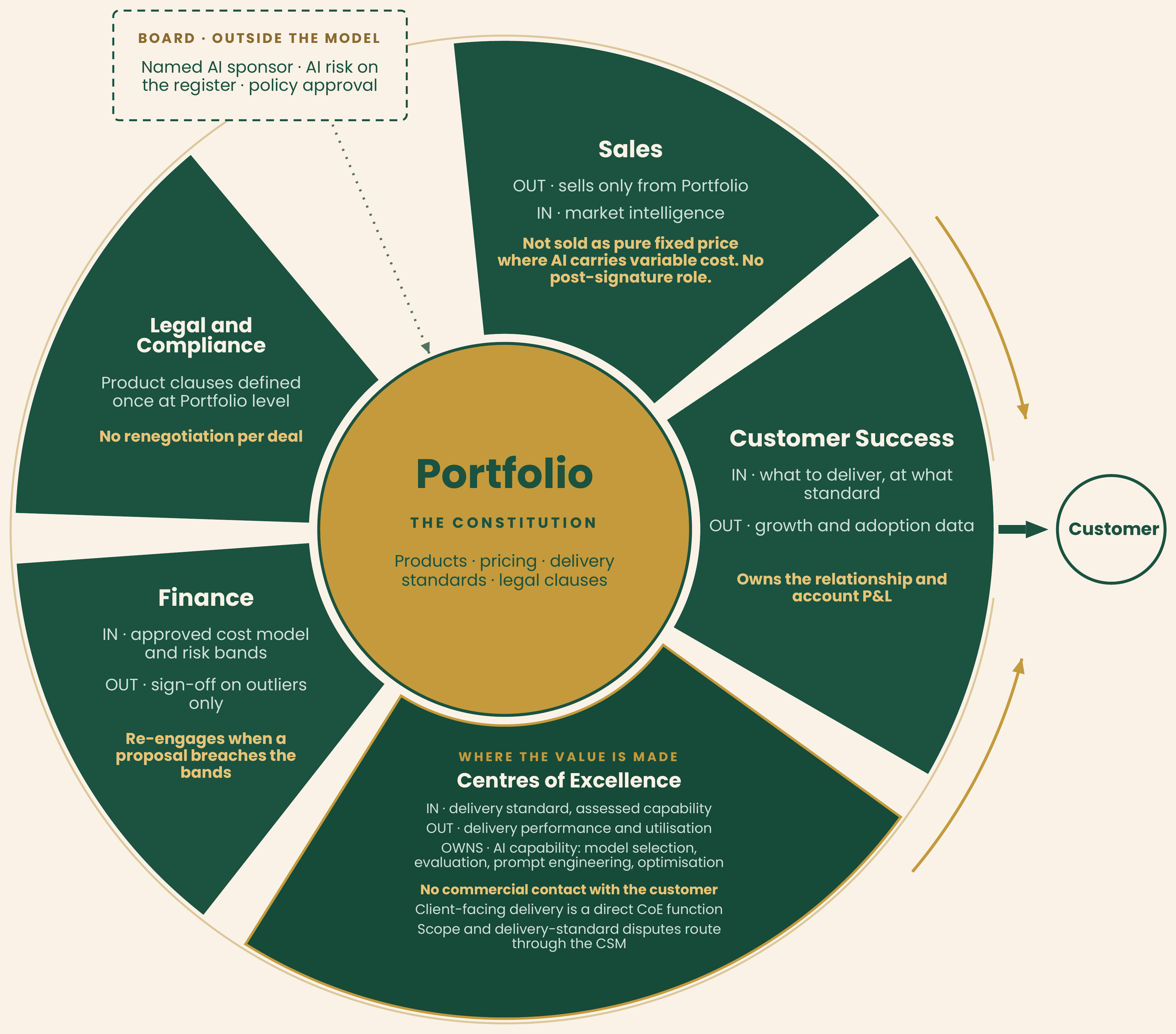
Most operating models work until they don't, fracturing as headcount, AI, or an acquisition changes what's being asked of them. CUSCOE is designed to absorb that change without a structural redesign at every threshold. Customer Success and Centres of Excellence, the two structural features the name comes from, are how it does that.
Customer Success is commercial-facing: the relationship, the P&L, the growth conversation. Centres of Excellence are delivery-facing: the standard, the capability, the performance. Neither absorbs the other's job as the business scales.
See it applied to CX & AI →The same logic works at 30 people or 500.
Function boundaries stay clear as headcount, customer volume and complexity grow. Centres of Excellence flex with demand rather than fragmenting into account-level silos. Growth doesn't force a structural redesign at every threshold, because the model was built for scale, not retrofitted to it.
Presents cleanly to an acquirer, absorbs a target cleanly too.
Function boundaries are defined, P&L accountability sits at account level, and the Portfolio is an authoritative record of what the business sells. No dependency on key individuals holding relationships informally. Due diligence is faster and lower-risk, and integrating an acquisition means mapping the same four functions onto it.
Sales sells only from the Portfolio, never a bespoke promise. Finance and Legal set the bands and clauses once, at Portfolio level, so nobody's renegotiating them mid-deal. That's the mechanism holding the Customer Success and Centres of Excellence split in place under commercial pressure.
The first stops Sales promising something outside the Portfolio. The second stops the split itself eroding, a Centre of Excellence drifting into commercial conversation it was never resourced or accountable for.
No sale outside Portfolio without written approval.
No CoE to customer commercial contact, ever.
Portfolio, Customer Success, Sales, and Centres of Excellence are the four core functions. Finance and Legal aren't separate functions in the model, they're where AI-specific risk bands and clauses get set once, at Portfolio level, so nobody's re-approving them deal by deal.
Products, pricing, delivery standards, product-specific legal clauses.
Nothing is sold, delivered or committed outside this without written approval.
IN · what to deliver, at what standard
OUT · growth and adoption data
Owns the relationship and account P&L from signature. The one gate out to the customer.
OUT · sells only from Portfolio
IN · market intelligence
No post-signature role. CRM ownership transfers to the CSM at signature, not later.
IN · delivery standard, assessed capability
OUT · delivery performance and utilisation
OWNS · AI capability: model selection, evaluation, prompt engineering, optimisation
No commercial contact with the customer. Scope and delivery-standard disputes route through the CSM.
IN · approved cost model and risk bands
OUT · sign-off on outliers only
Re-engages only when a proposal breaches the agreed bands.
Product clauses defined once at Portfolio level.
No renegotiation per deal.
Board oversight sits outside the day-to-day model: named AI sponsor, AI risk on the register, policy approval. One line into Portfolio governance, no arrow into the operational loop.

CUSCOE is CXBridge's own operating model, developed from 27 years of running CX and delivery functions, then written up and accepted as a position paper at KMIS 2026. The trademark is registered. It's the same model behind both the CX/AI diagnostic and Tollgate, applied to different problems, never changed to fit either.
CUSCOE underpins the CX and AI diagnostic, and it's the framework Tollgate tests an acquirer's operating model against before signature.
Talk to us about CUSCOE →